
Last updated August 11th, 2026
Significant Events
- Largest event: M4.7, 10 May 2026 00:10:21 PDT, (32.972, -115.562), depth 14.5km. 3km WSW of Brawley, California.
- As of 17 May 2026, 01:14PM PDT, the following event numbers have been recorded in the swarm:
- M≥4: 4
- M≥3: 18
- M≥2: 141
- All M4 events recorded:
Swarm Numbers
- As of 17 May 2026, 01:14PM PDT, we have recorded 494 events in the swarm (within a 20 km radius, and counting 5 days before the largest event). The smallest event is magnitude 0.8. Many of the smaller events are still being analyzed and will be gradually added to the catalogue.
- More activity is expected in the next few days, swarm activity in Southern California can continue for hours, days, weeks, months or years. For more information on swarms please see our Swarm page.
Relocated Sequence Model
This 3d model shows the locations of earthquakes in the 2026/07/23 and 2026/05/10 Brawley swarms, at the Salton Sea in Southern California. They were generated using a refined technique called HypoDD (Hypocenter Double-Difference) relocation, which determines earthquake locations by comparing pairs of nearby earthquakes recorded at the same station, rather than relying solely on the absolute travel time of waves through the Earth’s crust. The result is a much more accurate picture of where the earthquakes are actually occurring. Each circle represents one earthquake, with the size scaled to its magnitude and the color indicating when it happened, letting you see how the seismicity evolved over time. The large diamonds (red M3.6 7/23 and grey M4.7 5/10) mark the largest events in these sequences. The graphics clearly help reveal the geometry of the fault systems at depth.
Historical Seismicity
- Since our records began in 1932 we’ve had 132 events of M4 or greater within 10km of today’s event.
- The largest historic event was M5.8 on 1981/04/26.
- The most recent historic event was M4.5 on 10 May 2026.
- This swarm is similar to other swarms in proximity to the Salton Sea, and typical of the region.
- Historic swarm sequences in the region can be viewed in the figure below.
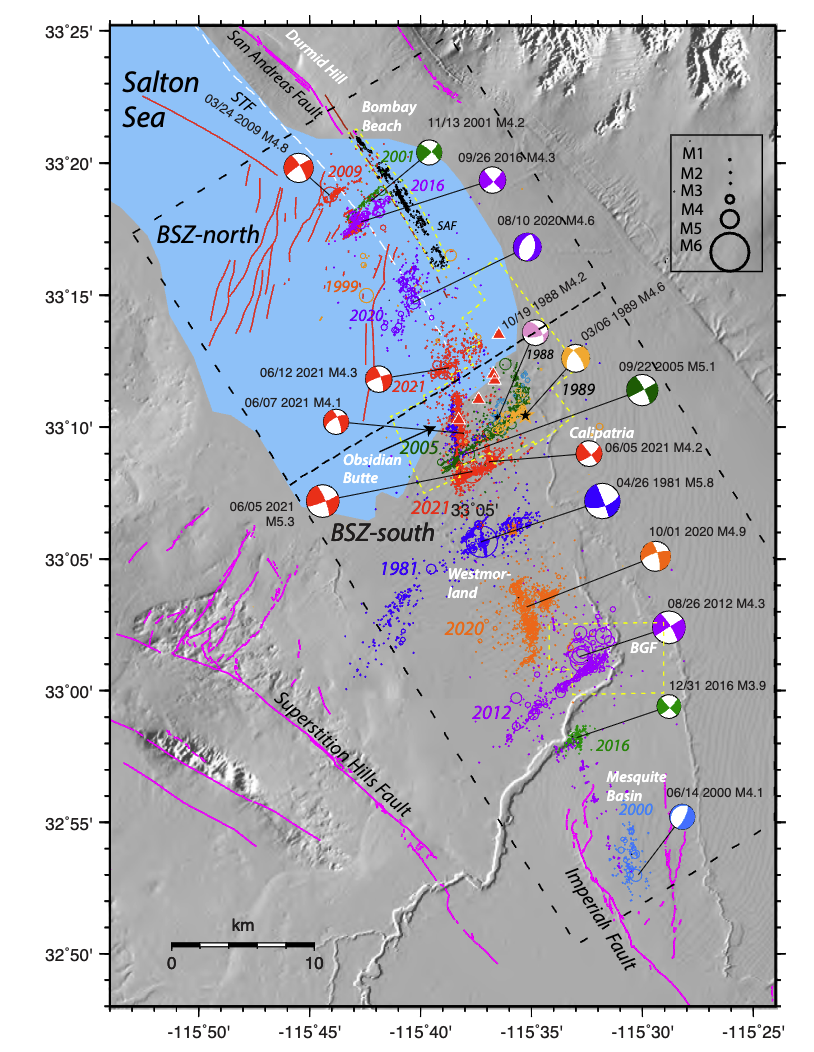
The San Andreas fault (SAF) clearly ends up in the Salton Sea. The edge of the North American plate and the Pacific Plate turns to extension as well as strike-slip in the Imperial valley and south into Mexico. So we get these cross cutting swarms between the SAF and the Imperial Valley fault until the plate interface continues south on the Imperial Valley fault.†
Faults
- CFM fault associations: most likely Brawley Seismic zone (100%).*
- Nearby faults: Imperial fault (4.1 km), Brawley seismic zone (Brawley fault zone) (8.0 km), San Jacinto fault zone, Superstition Hills section (Superstition Hills flt) (12.2 km), San Jacinto fault zone, Superstition Hills section (Wienert fault) (12.9 km) and Brawley seismic zone (13.1 km).**
Relocated Sequence Map
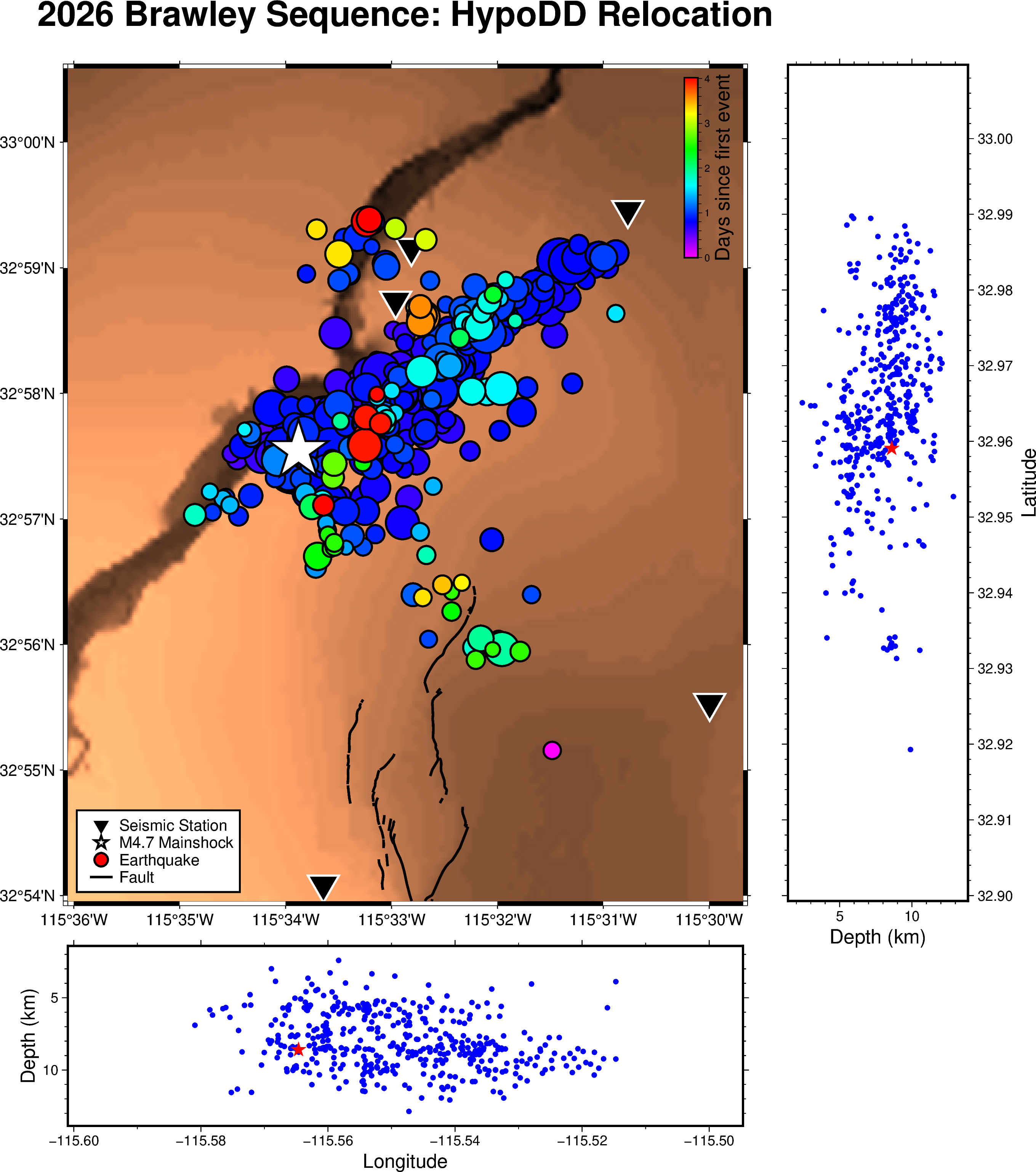
This map shows the locations of earthquakes in the 2026 Brawley swarm, centered near the Salton Sea in Southern California’s Imperial Valley. This map was generated using a refined technique called HypoDD (Hypocenter Double-Difference) relocation, which determines earthquake locations by comparing pairs of nearby earthquakes recorded at the same station, rather than relying solely on the absolute travel time of waves through the Earth’s crust. The result is a much more accurate picture of where the earthquakes are actually occurring. Each circle represents one earthquake, with the size scaled to its magnitude and the color indicating when it happened, letting you see how the seismicity evolved over time. The white star marks the largest event in this sequence so far, a M4.7. The two smaller panels along the bottom and right side show depth cross-sections, which help reveal the geometry of the fault system at depth. The map includes events from 5 days before the mainshock and is current as of 2026/05/13, 21:35:16 UTC.
Earthquake Early Warning Performance
- As of 11 May 2026, 09:30AM PDT, the ShakeAlert Earthquake Early Warning (EEW) System has activated on 9 earthquakes in this swarm, with three of the earthquakes having ShakeAlert magnitude estimates large enough to trigger public EEW alerts to cell phones:
- M 4.4 (41460112): ShakeAlert peak M 4.6, initial alert at 5.2 s after the start of the earthquake.
- M 4.5 (41460512): ShakeAlert peak M 5.1, initial alert at 5.4 s after the start of the earthquake. This event triggered ShakeAlert-powered alerts via the Wireless Emergency Alert System
- M 4.7 (41461608): ShakeAlert peak M 4.9, initial alert at 5.1 s after the start of the earthquake.
- For the events in this swarm, the ShakeAlert system has had a mean first alert time of 6.0 +/- 1.1 seconds after the start of the earthquake.
- The ShakeAlert System may be activated for additional earthquakes in this sequence.
- For more information about how the ShakeAlert system works, please see our Earthquake Early Warning page.Earthquake Early Warning page.
- For information about the alert thresholds and different EEW alert delivery mechanisms, go to ShakeAlert.org.
Additional Information
- Links for: USGS earthquake page, ShakeMap, DYFI, waveforms.
- Visit our special reports page for further information on local notable earthquakes.
Below are the waveform data associated with this event, as recorded in our Live Seismograms Feed.
†Hauksson, E., Stock, J. M., & Husker, A. L. (2022). Seismicity in a weak crust: the transtensional tectonics of the Brawley Seismic Zone section of the Pacific–North America Plate Boundary in Southern California, USA. Geophysical Journal International, 231(1), 717–735. https://doi.org/10.1093/gji/ggac205
*Earthquakes can occur both near or on major known faults, and in places where no clear fault zones are known. Using the statistical method of Evans et al. (in prep. 2019) the location and focal mechanism of this earthquake suggest the above association with modeled faults in the Community Fault Model (CFM) provided by the Southern California Earthquake Center (SCEC) and Harvard University. Note that the CFM fault association may be different from the nearby faults list. Differences may arise due to different fault databases, and because the CFM fault association uses the hypocenter with relation to subsurface 3-dimensional fault orientation models, while the nearby faults list utilizes mapped surface traces as they relate to the epicenter.
CFM Fault: SCEC CFM 7.0 Fault name and closest segment if available; The CFM is maintained by Harvard University, Dept of Earth & Planetary Sciences.
Probability: The probability in percent the earthquake is associated with this fault.
SCSN: Caltech/USGS Southern California Seismic Network
**U.S. Geological Survey and California Geological Survey, 2006, Quaternary fault and fold database for the United States, accessed 2015, from USGS web site: https://earthquake.usgs.gov/hazards/qfaults/
This information is subject to change as more up-to-date data become available.